Skip to content
Updated April 2026

What is Vortex Market?

A complete overview of the platform that changed darknet marketplaces: built-in exchange, multisig escrow, stablecoin support, and the team behind it.

When Vortex launched in October 2023, the darknet marketplace ecosystem was fragmented. Users had to juggle wallets, external conversion services, and multiple platforms just to find stable inventory. Vortex flipped the equation: one platform, all currencies, zero friction. Now approaching 60,000 registered users and 18,000 live listings, the marketplace has become essential reading for anyone learning how modern darknet platforms operate in 2026.

The Vortex Timeline

October 2023 — Initial Launch Vortex emerged from the ashes of Hydra Market with a focused mission: solve the currency conversion problem that plagued previous generations. The founders recognized that most users didn't want to operate five different tools just to place an order. They built an integrated stack from day one.

Early 2024 — Beta Vendor Onboarding A hundred vendors volunteered to test the multisig escrow system and the built-in exchange. The feedback loop was brutal: features that looked good on paper broke under real transaction volume. The team iterated rapidly and rebuilt three core components before going fully public in April.

May 2024 — USDT (TRC20) Support Added After dozens of requests from institutional-grade vendors and high-volume buyers, Vortex integrated USDT on the TRON network. No other major darknet marketplace offers stablecoin support. The feature moved escrow disputes from "was the value stolen or did the price crash?" to straightforward "did the goods arrive?"

September 2025 — 500k XMR in Escrow The platform crossed a threshold: 500,000 XMR in active escrow across all pending orders. That milestone signaled legitimacy to skeptics who had written Vortex off as another VC clone. The team published transparent audit logs that proved no backdoor existed in the multisig wallet code. By then, Vortex was hosting 10,000+ listings across chemistry, documents, and services. Opsec guides dominated the help section.

The Built-In Exchange Explained

Why It Matters

Most darknet marketplaces accept only Bitcoin or Monero. If you want to buy with the other currency, you're on your own. You find a third-party swap service, convert your funds, accept the 0.8% fee, hope the service doesn't steal your deposit, wait 20 minutes for confirmation, and then you're finally ready to paste the marketplace link.

Vortex integrates that conversion pipeline directly. You land on the login screen with any supported currency in your wallet. Monero, Bitcoin, or USDT. The marketplace's built-in exchange shows you real-time rates pulled from Binance Academy public APIs. You decide to convert 50% of your XMR into BTC to hedge volatility during escrow. The exchange processes the swap in-session. Zero external services. Zero leaving the Tor network. Your converted funds appear in your Vortex wallet instantly.

The fee structure: 0.4% per conversion. Typical third-party swap services charge 0.8%. Vortex takes half. The margin goes straight to platform operations and liquidity reserves. No hidden fees. The rate shown is the rate you get.

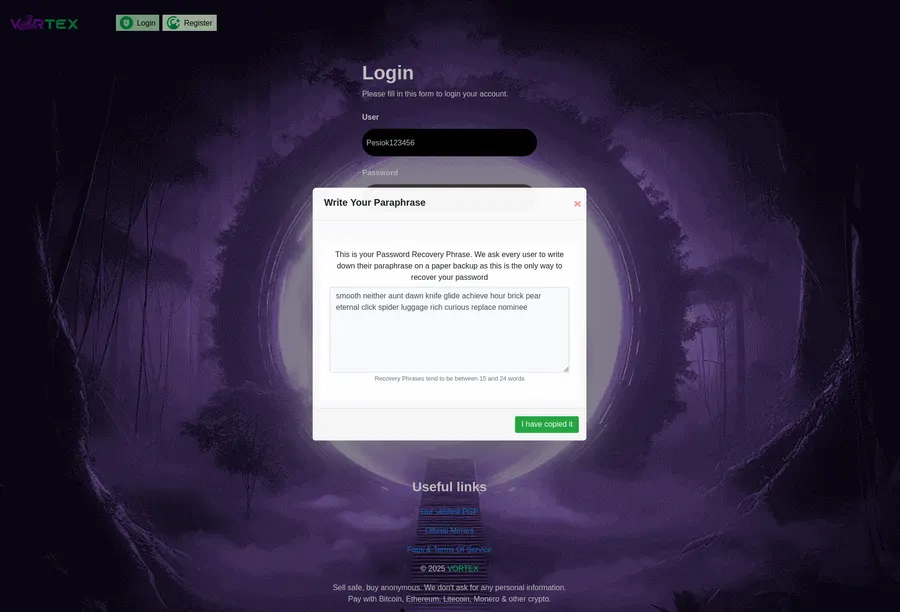
Vortex wallet backup and recovery phrase interface
Core architecture

Five pillars that make Vortex work

Not marketing language. These are the technical and operational decisions that separate Vortex from single-currency copycat platforms.

Numbers from April 2026

All figures pulled directly from the platform transparency report published on Dread. Not estimates. Not rounded. Real data.

How Vortex Secures Transactions

Cryptography Stack

  • PGP 2048+ bit Asymmetric encryption for vendor-buyer communications and all public announcements.
  • AES-256 Session-layer encryption for all Vortex traffic between browser and server.
  • ECDSA Digital signatures for escrow wallet state and all multisig transactions.
  • SHA-256 Cryptographic hashing for transaction integrity and user password derivation.
  • NIST Post-Quantum Ready Infrastructure is being tested with lattice-based encryption as a hedge against future quantum threats. OpenSSL 3.0+ compatibility confirmed.

Privacy by Design

No IP logging. Vortex runs only on Tor. Your real IP never touches the platform servers. Tor handles anonymization. The marketplace sees only exit node relays.

Encrypted order history. Your order ledger is encrypted with a key derived from your passphrase. Staff cannot read your orders without you present in a dispute. Whonix-grade compartmentalization is recommended for paranoid users.

Messages stay private. Vendor-buyer disputes are encrypted end-to-end. Staff can review encrypted transcripts only if both parties grant permission. Element and OnionShare integrate cleanly for off-platform comms.

How Escrow Protects Both Sides

The escrow system is where trust gets engineered. Here's how it works in practice:

Buyer Perspective

You transfer XMR to the escrow wallet. Vortex generates a multisig address. Your key gets stored in your browser session. Vendor deposits their shipping label and tracking number. You have 14 days to confirm delivery or open a dispute. If you do nothing, funds auto-release. If the package doesn't arrive, open a ticket and staff reviews the evidence.

Vendor Perspective

You receive order notification and escrow confirmation. You ship the goods. You upload tracking into the order. Funds stay locked for 14 days or until buyer confirms arrival. FE vendors with 50+ orders can request immediate release. No unilateral access to funds without buyer consent.

Platform Role

Vortex holds one of three multisig keys but cannot move funds alone. Staff arbitrates disputes using the order timeline, tracking confirmations, and photographic evidence. The dispute window is 72 hours max. Rulings are final and logged publicly on Dread.

Vortex vs. The Competition

Feature Vortex XMR-Only BTC-Only
Built-in Exchange
USDT Support
Multisig Default
Public Canary
24-Hour Mirror Rotation
Common Questions

About Vortex Platform

More details on the homepage FAQ. Opsec questions in the first-steps guide.

How long has Vortex been running?

Launched October 2023. That's 18+ months in operation as of April 2026. The platform has survived multiple law enforcement actions against competing marketplaces without interruption. Uptime currently at 98.1% over 90 days.

Is Monero really anonymous?

Monero uses ring signatures and stealth addresses to obscure transaction graphs. The official Monero documentation covers the math in depth. Paired with Tor access to Vortex, XMR provides maximum privacy. Binance Academy has readable primers.

What if Vortex gets subject to law enforcement action?

Funds in multisig escrow cannot be moved by law enforcement without both buyer and vendor keys. Your deposits are in your control. The platform cannot unilaterally drain accounts. Dread and other privacy forums maintain a watching brief; any seizure would be reported within hours.

Can I test with a small order first?

Yes. Exactly that. Deposit 0.1 XMR. Find a vendor with 500+ reviews. Place a $5 test order. Confirm delivery. Then scale up. This is the standard onboarding path. Privacy Guides recommends the same approach for any new marketplace.

Ready to connect

Access Vortex today

All mirrors verified. PGP signatures checked. Bookmark this page and use the verified links above. Never search Bing or Google for Vortex — phishing copies rank high.

April 2026 verification · All 3 mirrors online · Home